Tariffs

Blurb:

Sweeping tariff increases on imports from China and other countries without free trade agreements (FTAs) with Mexico officially took effect Jan. 1, marking a significant shift in the country’s trade policy aimed at protecting domestic industries and jobs.

The tariff modifications, published in Mexico’s Official Gazette on Dec. 30, affect 1,463 product categories across more than a dozen sectors including automotive, textiles, clothing, steel, plastics, footwear, furniture, toys, aluminum and glass. The new duties range from 5% to 50%, with the highest rates applied to vehicles from China and certain other Asian nations.
Blurb:

The resurgence of the political right in Latin America and Mexico’s recently approved tariffs were among the issues spoken about at President Claudia Sheinbaum’s Monday morning press conference.

Here is a recap of the president’s Dec. 15 mañanera.

Sheinbaum: Shift to the right won’t happen in Mexico 

Citing the victory of José Antonio Kast in Chile’s presidential election on Sunday as well as the results of recent elections in Argentina and Bolivia, a reporter asked the president about the shift to the right of “some voters in Latin America.”

Sheinbaum responded that the situation in “each country” would need to be analyzed to determine why voters in some Latin American nations have recently supported right-wing candidates and parties in large numbers.

Blurb:

Korea Zinc announced on Monday a $7.4 billion smelter project in Tennessee that will be backed by the U.S. government and which will lessen our reliance on China for critical minerals used in defense systems, electronics, and so much more that powers our modern world.

Commerce Secretary Howard Lutnick took to X to laud the news:

Blurb:


Another South American country has gone “far-right” and the timing couldn’t be better for the U.S. as it seeks to secure its critical mineral supply chain.

Several weeks ago, Bolivia elected Rodrigo Paz as its new president. He promptly planned to scrap a ream of taxes as one of his first moves since becoming the nation’s first conservative leader in nearly two decades.

The government has also repaired relations with Washington after years of anti-American hostility dating back to when ex-President Evo Morales, a charismatic coca-growing union leader, kicked out the U.S. Drug Enforcement Administration in 2008 and cozied up to Russia, Iran and Venezuela.

The U.S. State Department has already announced agreements on nuclear cooperation and security assistance, and Paz has said his administration will allow Elon Musk’s Starlink to operate in Bolivia for the first time, after his predecessor refused to give it an operating license last year.

Blurb:

The U.S. Supreme Court appeared fairly skeptical of President Trump’s implementation of numerous “emergency” tariffs in a pair of key cases before the bench on Wednesday.

The nation’s highest court held oral arguments in Learning Resources, Inc. v. Trump and Trump v. V.O.S. Selections, Inc. The cases center around the legality of Trump’s implementation of tariffs using the International Emergency Economic Powers Act (IEEPA), which grants presidents the power to “deal with any unusual and extraordinary threat, which has its source in whole or substantial part outside the United States, to the national security, foreign policy, or economy of the United States, if the President declares a national emergency with respect to such threat.”

As The Federalist previously described, the president “did so in response to existing ‘unfair trade practices’ that lead to trade deficits, as well as to punish countries like China for failing to ‘blunt the sustained influx of synthetic opioids, including fentanyl, flowing from the [People’s Republic of China] to the United States.’” Invoking language contained in IEEPA, Trump reasoned that these problems represent an “unusual and extraordinary threat” to the country.

Blurb:

News roundup:

Supreme Court justices appear skeptical of Trump’s tariffs, but some may give leeway

ICE to open call center to help track migrant children for removal

FAA is cutting flights at 40 major airports amid government shutdown

Inside Trump’s “uncomfortable” breakfast with Republican senators

Trump sways some Republican senators on filibuster changes

Democrats tap the brakes on ending government shutdown

St. Paul, Minnesota, Elects Mayor Who Admitted, ‘I Am Illegal in This Country’

Immigration Rights Activists Ask Los Angeles Dodgers to Decline White House Visit over ICE Raids

Trump Highlights Economic Bright Spots in American Business Forum Speech

GOP Sen. Kennedy to Introduce Bills to Withhold Pay from Lawmakers During Government Shutdown

FDNY Commissioner Hands In Resignation Less than 12 Hours After Mamdani Win, Other Top Officials Expected to Follow Suit

Chinese scholars charged with smuggling biological materials into US under research cover

Mamdani’s socialist and Muslim backers, including Sarsour and Wahhaj, take victory lap

Justice Department charges third man in connection to alleged Halloween terror plot

15-year-old Florida boy guns down classmate after victim bumped him in school hallway: sheriff

Bomb Threats At NJ Polling Stations Connected To Russian Email Address

Trump Announces Major Decision On Nuclear Weapons

Pressure Mounts For Dem Governor To Call In National Guard After Spate Of High-Profile Murders

And that’s all I’ve got, now go beat back the angry mob!


from amgreatness.com

Blurb:

Shares of Europe’s biggest carmakers rose Monday as fears over an industry shortage of semiconductors appeared to recede.

China on Saturday said it would consider some exemptions for Nexperia chip exports. It had previously blocked Nexperia semiconductors from leaving the country after the Dutch government seized control of Nexperia, owned by the Chinese company Wingtech.

The standoff between the Netherlands and China had prompted automotive groups to raise the alarm over a worsening chip shortage.

Blurb:

In a stunning act of political miscalculation, Canada aired a deceptive tariff ad featuring President Reagan to taunt Donald Trump — prompting Trump to retaliate by raising tariffs on Canadian goods. To call it “stupid” is far too generous; it was a reckless act of self-sabotage.

The person responsible for this misleading ad is Doug Ford; the premier of the province of Ontario. Ford thought that this attack ad would scare President Trump into retreating from his tariff policy. Ford was dead wrong. In response to this attack ad, President Trump has suspended trade negotiations with Canada, and has also increased tariff’s on Canada by an additional 10 percent. Doug Ford is a clown.

Blurb:

Recently, in an unprecedented move, Ontario’s provincial government intruded in American politics by trying to divide the Republican Party regarding tariff policy.  They did this knowing that there are two strands of GOP thought on tariffs: a pro-free trade belief, and a pro-tariff belief, which the Canadians hope to exploit in their ongoing trade battles with the U.S.

Which brings me neatly back to the issue of higher tariffs.  Once again, I am analyzing this as a political issue, and not as an economic one.

The historical GOP was a big fan of tariffs.  Abraham Lincoln brought them over from the “American System” of the Whig party, of which he was a prominent proponent.  In 1896, the GOP doubled down on them under William McKinley, whom President Trump has praised.

Blurb:

US President Donald Trump and Indian Prime Minister Narendra Modi arrive to hold a joint press conference in the East Room of the White House in Washington, DC, on February 13, 2025.

The U.S. could substantially slash tariffs on Indian exports as the two countries near a trade deal that could see New Delhi cutting oil purchases from Russia, Indian media outlet Mint reported Wednesday.

As part of the trade deal, Washington could slash tariffs on Indian exports to 15%-16% from the current 50%, Mint reported citing three unnamed sources aware of the matter.

Blurb:

President Donald Trump and Australian Prime Minister Anthony Albanese signed a critical minerals agreement to counter China, which is holding tight to its own rare earth metals.

According to Bloomberg, Australia “holds the world’s fourth-largest deposits of rare earths.”

With China trying to control the rare earths and critical minerals market, Australia hopes to become “a viable alternative” for countries.

Australia has these key elements:

  • Neodymium and praseodymium: needed for high-strength magnets for electric vehicles and wind turbines
  • Dysprosium and terbium: needed for magnets used in high temperatures
  • Lanthanum and cerium: used in catalytic converters and batteries
  • Europium and gadolinium: needed for phosphors used in screens and medical imaging
  • Samarium: used in high-temperature permanent magnets and lasers


Trump’s lowered 15% tariff on cars from Japan to take effect Tuesday– japantoday.com
Source Link
Excerpt:

U.S. President Donald Trump’s lowered tariff of 15 percent on automobiles from Japan will take effect Tuesday, the Commerce Department said, about four months after his aggressive trade agenda started damaging the industrial backbone of one of Washington’s key allies.

The department announced the timing of the adjustment on Monday. The U.S. tariff rate for foreign-origin cars rose to 27.5 percent after Trump imposed in April an additional auto tariff on national security grounds, squeezing the margins of Japanese automakers and other manufacturers.

The reduced tariff is part of a trade deal the Trump administration struck on July 22 with Japan, which in return has committed to investing heavily in the United States and increasing imports of American agricultural products during the president’s nonconsecutive second term.

Trump signed an executive order on Sept. 4 formally implementing the trade agreement, which also granted Japan special treatment on what he calls “reciprocal” tariffs.

The department’s notice to be published Tuesday said that as agreed by the two countries, Trump’s additional 25 percent tariff imposed in May on major auto parts, including engines and transmissions, will also be cut to 15 percent for those coming from Japan.

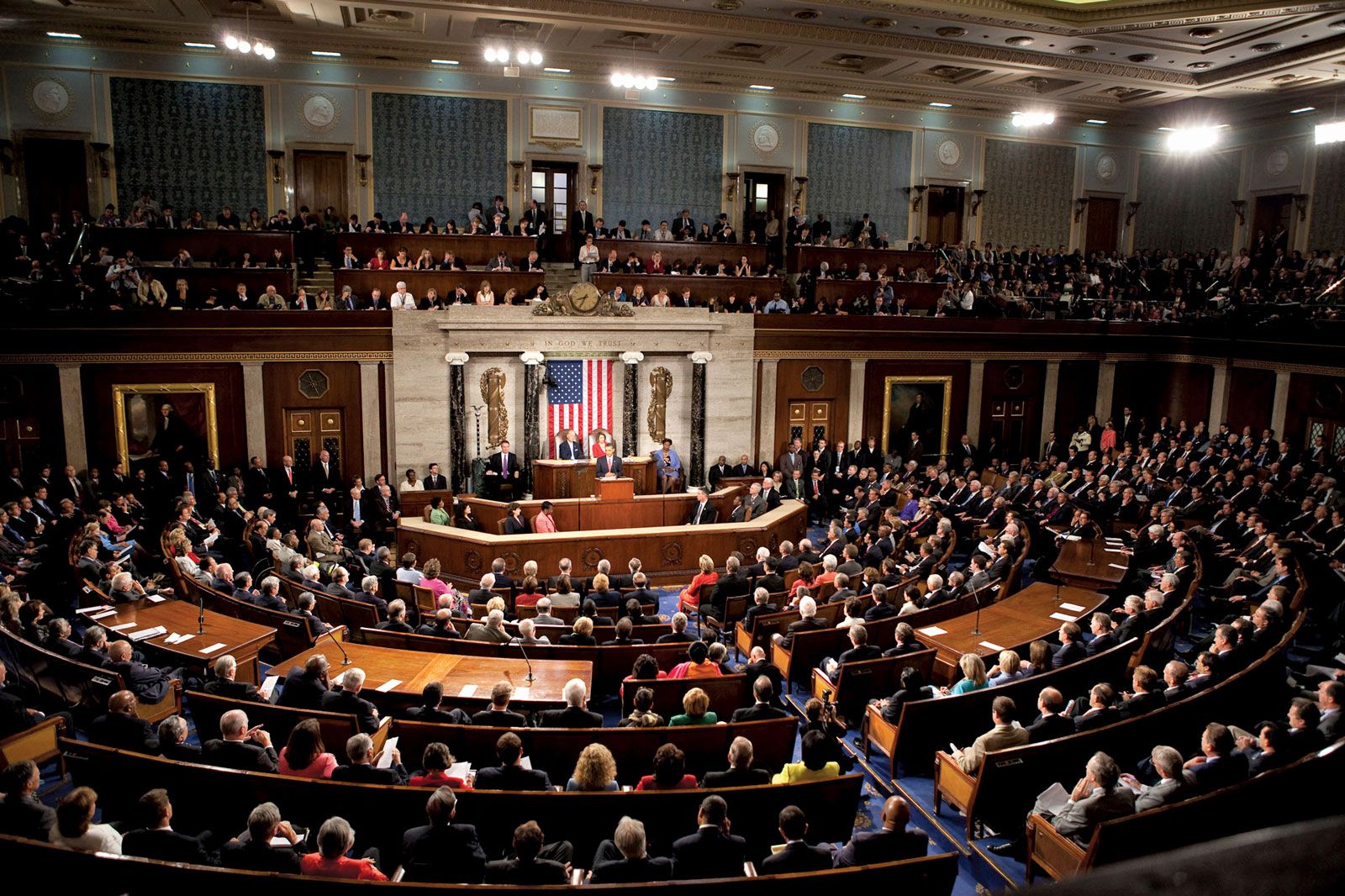
House of Representatives | Definition, History, & Facts | Britannica

House of Representatives | Definition, History, & Facts | Britannica

House GOP leaders move to extend block on tariff termination votes– www.politico.com
Source Link
Excerpt:

House Republican leaders are moving to again head off votes trying to cancel much of President Donald Trump’s sweeping tariff regime.

A procedural measure Republicans on the Rules Committee advanced Monday night would extend until March 31 a block on efforts by Democrats and several Republicans to end the national emergencies underlying Trump’s sweeping tariffs — including on Mexico, Canada, Brazil and his “liberation day” levies from April.

It would also block “resolutions of inquiry,” measures that can be used by the House to compel the release of information from the executive branch.

The House is set to vote Tuesday on the measure, which also tees up several D.C. crime- and governance-related bills for floor debate.

GOP leaders have struggled to keep their ranks in line on tariff-related votes. On Monday, their bid to strangle a Democratic-led effort to end Trump’s Brazil levies succeeded only narrowly, 200-198.

Source Link
Excerpt:

Goldman Sachs is taking the heat for its call that heavier tariff-induced consumer inflation is ahead, but it’s far from alone in that view among its Wall Street brethren.

Despite investors’ embrace of Tuesday’s fairly benign consumer price index report, economists expect that the biggest impact to inflation is yet to come.

With pre-tariff inventories rolling off, effective tariff rates climbing higher and companies less willing to absorb higher costs from the duties, the general feeling is that consumers are increasingly going to feel the bite through the rest of the year.