06 Market

The first person to get a Neuralink chip in his brain says he met Elon Musk on the day of his surgery: ‘He’s a cool dude’– fortune.com
Source Link
Excerpt:

Attendees at Fortune’s Brainstorm Tech conference last week witnessed a demonstration of both technological innovation and human resilience when Noland Arbaugh, the first human recipient of Neuralink’s brain-computer interface (BCI) chip, played chess using only his thoughts. Arbaugh also shared candid insights into his pioneering journey, including his memorable first encounter with Neuralink’s cofounder and the world’s richest man, Elon Musk.

Arbaugh’s journey began with a diving accident at a summer camp in 2016, which left the former Texas A&M student paralyzed from the shoulders down and largely dependent on his family. For years, Arbaugh lived what he describes as a severely limited existence.

“I would stay up all hours of [the] night, just sleep in whenever, wake up whenever I wanted to because I didn’t really have anything planned, didn’t have anything going on in my life,” he told Fortune senior writer Jessica Mathews during their conversation. Arbaugh said he left his house only a couple of times per year.

“Before Neuralink, I thought I would never travel again,” he said. “[I] thought I would just stay in my room.”

JD Foster: Trump Is Right In Calling For The End To Quarterly Reporting– dailycaller.com
Source Link
Excerpt:

Sometimes, it’s the little things. Sometimes, it’s bigger things. This time it’s the quarterly earnings report required by law of America’s publicly traded companies. And it’s President Trump suggesting on Truth Social that we should do away with quarterly earnings statements in favor of bi-annual statements. He’s right.

The Securities and Exchange Commission (SEC) requires publicly traded companies to report their earnings quarterly. In contrast, the hyper-regulative European Union and United Kingdom require six-month reporting, though corporations are allowed to make quarterly statements if they want.

Quarterly reporting is just one of the hundreds of rules U.S. publicly traded companies face that privately held companies don’t. Nearly all of these rules make some sense in isolation, but collectively they represent an enormous burden, one effect of which is that even as the American economy has grown steadily over the years, the number of publicly traded companies had fallen by half. Houston, we have a problem.

Quarterly reporting is expensive to the corporation and a major time burden for senior management. These are relative nuisances.
Trump’s lowered 15% tariff on cars from Japan to take effect Tuesday– japantoday.com
Source Link
Excerpt:

U.S. President Donald Trump’s lowered tariff of 15 percent on automobiles from Japan will take effect Tuesday, the Commerce Department said, about four months after his aggressive trade agenda started damaging the industrial backbone of one of Washington’s key allies.

The department announced the timing of the adjustment on Monday. The U.S. tariff rate for foreign-origin cars rose to 27.5 percent after Trump imposed in April an additional auto tariff on national security grounds, squeezing the margins of Japanese automakers and other manufacturers.

The reduced tariff is part of a trade deal the Trump administration struck on July 22 with Japan, which in return has committed to investing heavily in the United States and increasing imports of American agricultural products during the president’s nonconsecutive second term.

Trump signed an executive order on Sept. 4 formally implementing the trade agreement, which also granted Japan special treatment on what he calls “reciprocal” tariffs.

The department’s notice to be published Tuesday said that as agreed by the two countries, Trump’s additional 25 percent tariff imposed in May on major auto parts, including engines and transmissions, will also be cut to 15 percent for those coming from Japan.

YouTube’s paid creators $100 billion in four years– mashable.com
Source Link
Excerpt:

There’s a reason creators often try to migrate their audience to YouTube: It pays.

The Google-owned streaming giant said it has paid out more than $100 billion in the last four years to creators, artists, and media companies. YouTube announced the figure at the Made on YouTube event on Tuesday.

“We didn’t just create a platform. We built an economy,” said YouTube CEO Neal Mohan.

As Mashable reported earlier this year, creator jobs have grown 7.5 times in recent years. In surveys, young people also consistently identify being a creator as a popular career goal. And YouTube has played an outsized role in building the modern creator economy.

It pays to be a popular creator and/or influencer on any platform, but YouTube’s widely regarded as the most lucrative social media site when it comes to direct view-to-payment value. And creators are making more money off of folks watching YouTube on traditional TV sets, rather than mobile devices. The company reported that the number of YouTube channels making more than $100,000 from TV screens rose 45 percent year over year.

Clearly, YouTube isn’t just for streamers anymore. Heck, the platform is broadcasting NFL games — arguably the single biggest product in American culture — with great success. But if you want to make it big as a creator, YouTube remains the place where you can carve out a highly lucrative living.

Fed Budget at a Crossroads as 2024 CR Nears Expiration

Fed Budget at a Crossroads as 2024 CR Nears Expiration

Republicans Are Forcing A Government Shutdown And Trump Will Be Blamed– www.politicususa.com
Source Link
Excerpt:

The White House thinks that the current government funding debate can be won just like the last one was in March. They believe that nothing has changed, and they can pass a bill to keep the government open by putting Senate Democrats up against a deadline with no negotiations.

The political climate has changed.

The White House doesn’t see it, which is why Trump and his party are about to step on the rake and smack themselves in the face with a government shutdown.

Punchbowl News reported:

The House Republican leadership plans to put a bill on the floor this week to keep the federal government open through Nov. 20, a strategy aimed at giving appropriators another seven weeks to hash out a broader spending deal for the FY2026 bills.

Republicans are saying the CR will be “clean” — free of partisan policy riders.

But as we’ve reported, the GOP proposal doesn’t include any of the Democrats’ demands. Senate Minority Leader Chuck Schumer and House Minority Leader Hakeem Jeffries have said they can’t vote for any CR unless it includes health care-related provisions.

It’s not clear if Democrats are demanding that Republicans renew enhanced premium subsidies for Obamacare or restore OBBB Medicaid cuts. Rather, Schumer and Jeffries have simply called on Republicans to negotiate.

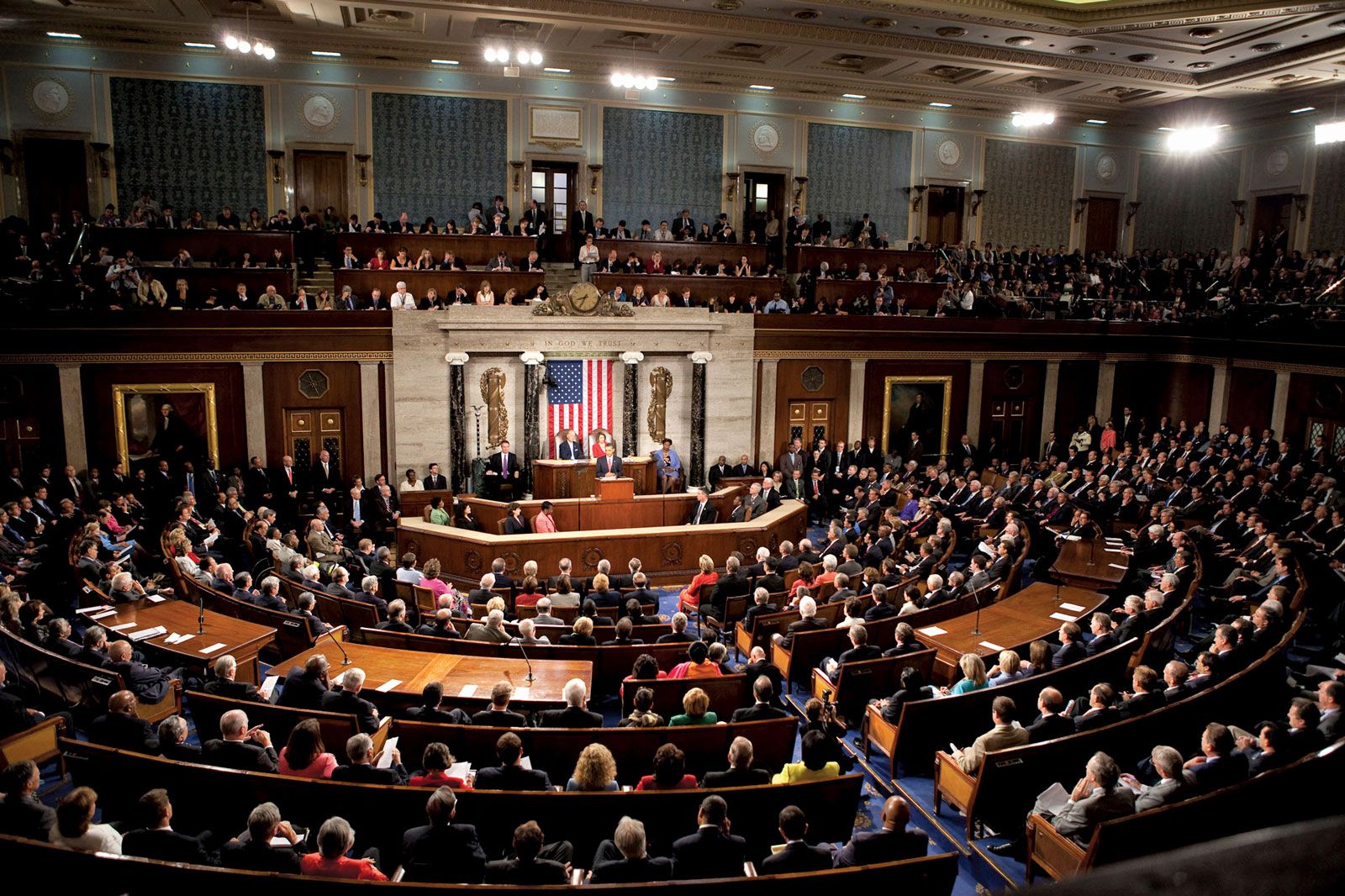
House of Representatives | Definition, History, & Facts | Britannica

House of Representatives | Definition, History, & Facts | Britannica

House GOP leaders move to extend block on tariff termination votes– www.politico.com
Source Link
Excerpt:

House Republican leaders are moving to again head off votes trying to cancel much of President Donald Trump’s sweeping tariff regime.

A procedural measure Republicans on the Rules Committee advanced Monday night would extend until March 31 a block on efforts by Democrats and several Republicans to end the national emergencies underlying Trump’s sweeping tariffs — including on Mexico, Canada, Brazil and his “liberation day” levies from April.

It would also block “resolutions of inquiry,” measures that can be used by the House to compel the release of information from the executive branch.

The House is set to vote Tuesday on the measure, which also tees up several D.C. crime- and governance-related bills for floor debate.

GOP leaders have struggled to keep their ranks in line on tariff-related votes. On Monday, their bid to strangle a Democratic-led effort to end Trump’s Brazil levies succeeded only narrowly, 200-198.

TikTok ‘framework’ deal overshadows U.S.-China trade talks– www.cnbc.com
Source Link
Excerpt:

U.S. and Chinese trade negotiations concluded in Spain Monday, after two days of talks on several sticking points ranging from tariff rates, export controls and the imminent deadline for a divestment of Chinese-owned TikTok.

Talks on trade were overshadowed by a “framework” deal regarding the social media platform, announced by Treasury Secretary Scott Bessent Monday.

“It’s between two private parties, but the commercial terms have been agreed upon,” he said from U.S.-China talks in Madrid. Both President Donald Trump and Chinese President Xi Jinping will speak on Friday to discuss the terms.

The news comes ahead of a Wednesday deadline to either divest TikTok’s U.S. business or shut down the social media app in the country.

Bessent led negotiations alongside Trade Representative Jamieson Greer on the U.S. side, with the Chinese represented by Vice Premier He Lifeng and top trade negotiator Li Chenggang.

Trump to sign nuclear energy deal with UK– www.washingtonexaminer.com
Source Link
Excerpt:

LONDON — The United States will finalize a new nuclear energy agreement with British leaders during President Donald Trump‘s state visit to the United Kingdom this week.

Trump will touch down in London on Tuesday before spending Wednesday at Windsor Castle with King Charles III, capped by a lavish state banquet in the evening.

The nuclear agreement itself, which British government officials said “will turbocharge the build-out of new nuclear power stations in both countries and clear the way for a major expansion of new nuclear projects in the U.K.,” will be signed on Thursday during a slate of bilateral meetings between Trump and British Prime Minister Keir Starmer.

“This landmark UK-US nuclear partnership is not just about powering our homes, it’s about powering our economy, our communities, and our ambition. These major commitments set us well on course to a golden age of nuclear that will drive down household bills in the long run, while delivering thousands of good jobs in the short term,” Starmer said in a statement to the Washington Examiner. “Together with the US, we’re building a golden age of nuclear that puts both countries at the forefront of global innovation and investment.”

Trump’s energy secretary, Chris Wright, said the administration is “ushering in a true nuclear renaissance — harnessing the power of commercial nuclear to meet rising energy demand and fuel the AI revolution.”

Interior Secretary Doug Burgum added, “Strengthened nuclear cooperation with the UK reinforces our unshakable commitment to technological leadership, global security and the responsible stewardship of nuclear power. This is how we unleash the full power of American Energy Dominance — with innovation, strength, and key geopolitical collaboration.”